AWAC tilt limits

Up to Waves

AWAC tilt limits

Posted by Torstein Pedersen at April 04. 2009

The following question was recently presented on the forum in another discussion thread.  I have moved it here since it is important to understand for system performance and deserves its own attention.


Hello mister Atle

I'm write from Chile, and i need answer the following questions to AWAC 600 kHz

1. Confirm that the Pitch an Roll readings must be between +-5° for clasificate a data, how, good data

2. What is the Heading range? Is the same that Pitch and Roll; +-5°

3. Is posible that Nortek, check the attitude parameters?

thanks, best regards,

Juan Pablo

(The file size is 5.022 KB) impossible attach.

Tilt

Juan, for the wave measurements the tilt becomes important for the performance of the AST.  The velocity measurements and processing are not as sensitive to tilt. 

The acoustic energy from the AST ping reflecting from the surface becomes more more reduced as an AWAC becomes more and more tilted.  The magic number for permissible tilt is 10 degrees; above this one will see that finding the ocean surface becomes challenging when attemping wave measurements.  What often happens is that the there are too many samples which we refer to as Bad Detects  and a wave burst can not be properly processed.  It is for this very reason that we do not bother to use the three other beams for AST measurements; these beams are angled at 25 degrees from vertical and would give poor results.

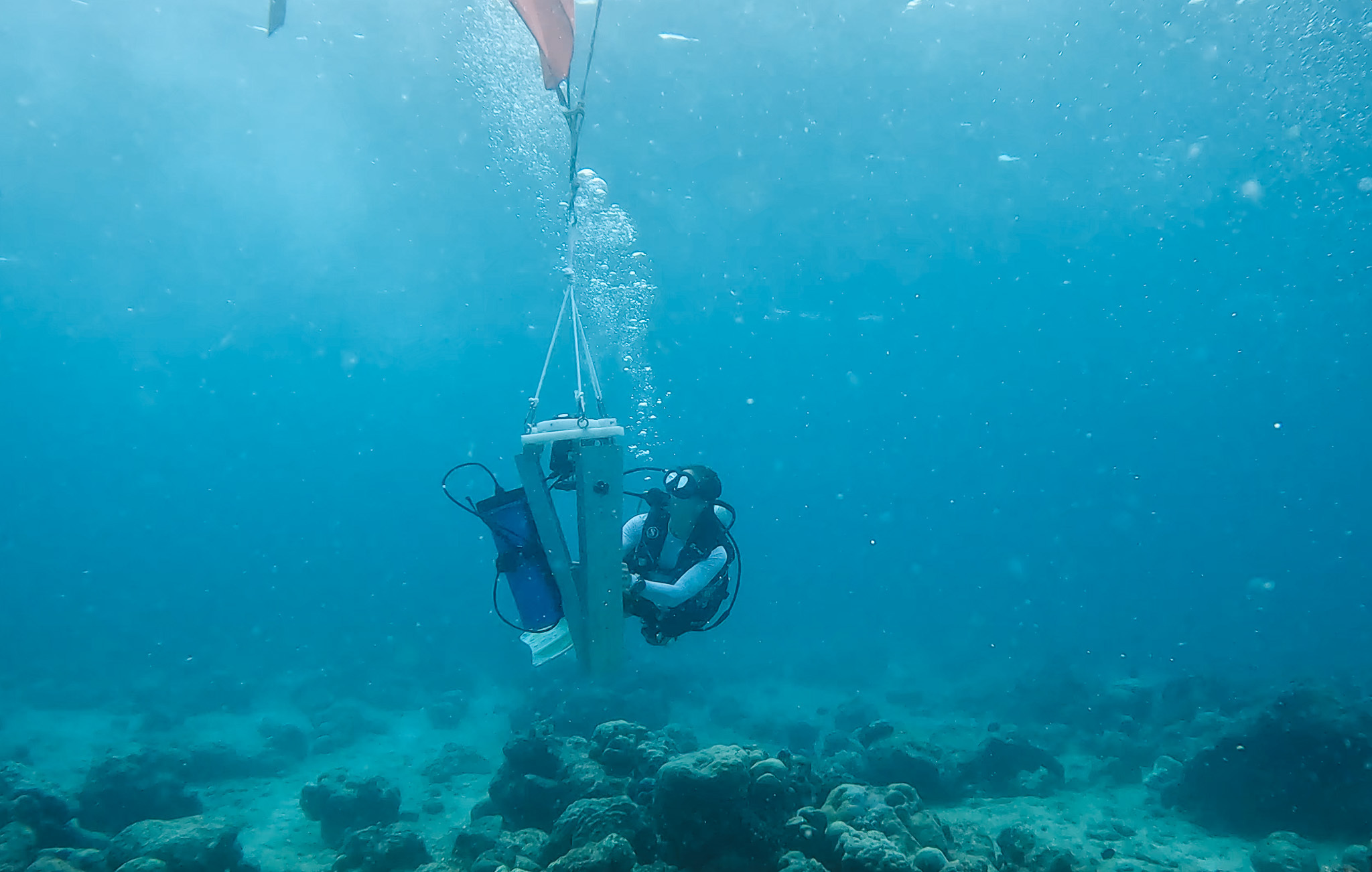
The resulting tilt from the combined pitch and roll seems to really deteriorate above 10 degrees, however we at Nortek encourage our users to try their best to have the AWAC deployed within 5 degrees of vertical.  This may seem challenging for some types of deployments, so you may want to consider either deploying with a diver who can manually position the frame or use a gimbal which ensures vertical orientation.  

As a side note, an AWAC deployed on a subsurface buoy has demonstrated to maintain vertical orientation within our specified tilt limits and AST performance is typically very similar to a bottom mounted AWAC.


Heading

The heading should really be stable for a bottom mounted if it is moving then you will likely see a small degree of error in the directional wave estimates (as well as current measurements).   I suspect that if this happens it is during large wave events and/or shallow water deployments where bottom currents from the waves are strong.  If you are seeing this throughout the deployment then you may want to reconsider how the AWAC is fixed to the bottom (anchored or weighted).  

But back to Juan's original question, if the heading changes during a wave burst, then this will be reflected in the directional estimate.  How much it changes,  how it changes (back and forth or one big change), and when the heading changed in the burst it changes will all effect the directional estimate.  I suspect that oscillating heading will simply smear the directional estimates but the mean may still be "reasonable".  Large jumps and when they occur in the burst are more difficult to say how much they effect the resulting wave estimates.

We have no firm recogmendation for heading limits, but I like your suggestion of keeping it under 5 degrees :)

One solution to the problem of heading changes is to configure the AWAC wave measurements to collect data in SUV mode.  This will account for changes in the heading for each wave sample ;)


 Juan, I would be happy to have a look at your data.  You may post it on our ftp site:

ftp://nortek-as.com/pub/incoming

After you have posted the file, please send an email to inquiry@nortek.no to let us know it is there and tell us what you would like like us to have a look at.


kind regards,

Torstein


Current state: Being created

Re: AWAC tilt limits

Posted by JUAN PABLO VERA G at April 07. 2009

Mr. Torstein


I posted the .wpr file in your ftp aplication, yesterday monday.

You can see the status parameters Pitch and Roll under 2° betwenn juanary 10 and february 7 (27 days), but after, the AWAC move 15°.

regards,

Juan Pablo VERA G.

Current state: Being created

Re: AWAC tilt limits

Posted by Camille Couzi at August 10. 2011

Hi Torstein,

I post my message after this post, even if it is more than 2years old, as I am having the same type of concerns as Juan Pablo.

You said in your replay that "For the wave measurements the tilt becomes important for the performance of the AST.  The velocity measurements and processing are not as sensitive to tilt", does this means that if I have pitch and roll values exceeding 10 degrees and heading exceeding 5 degrees, it will affect my WAVES data, but not my CURRENT data? i.e., can i still consider my current data right?

Thanks in advance for your reply,

Regards,

Camille.

Re: AWAC tilt limits

Posted by Jonas Røstad at August 10. 2011
Dear Camille,
 
Your tilted current measurement should be OK. One thing you should consider is the position of the cells. Please have a look at http://www.nortek-as.com/en/knowledge-center/forum/current-profilers-and-current-meters/657830882#42977670 for details.
For changes in heading this may affect the direction of the currents measured. One major difference is that a current profile is done within 60 s (typically) while a wave burst is 17 minutes (typically). If it still is a worry the compass update rate is user selectable at the deployment planning's advanced page.
 
Best regards
Jonas Røstad


Re: AWAC tilt limits

Posted by Camille Couzi at August 12. 2011

Hi Jonas,

Thanks a lot for the help. I am going to process my data using Surge. However, I have a question about the "remove tilt effects" option. I am going to put my question after the posts in  http://www.nortek-as.com/en/knowledge-center/forum/current-profilers-and-current-meters/657830882#42977670 .

Thanks!

Camille.

Re: AWAC tilt limits

Posted by Camille Couzi at September 07. 2011

Hi again!

I have a question about correction of wave data when the AWAC is tilted between 5 and 10 degrees: is there a way to correct the wave data? I can retrieve the WAP data and of course I can see -99999 default values for some ensembles and some variables, but is there a way to correct the remaining values?

When pitch and roll are more than 10degrees, can you please confirm that the data is completely lost and there is nothing to do on it?


Thanks a lot for the information!

Camille.

Re: AWAC tilt limits

Posted by Jonas Røstad at September 07. 2011

Hi Camille,


Even though the AST fails it is possible to calculated wave parameters.

Since the AWAC has the capability to measure waves in three different ways, and records all the data necessary for all of them, we simply fall back to the next best processing technique.

I do not know how you process waves, but if you have QuickWave or Storm the processing techniques are user selectable in the processing settings.
The three possible measurements to choose between are: Pressure, Velocity, and Acoustic Surface Tracking (AST).  This choice specifies which measurement will be used to calculate the non-directional or Energy spectrum.  When the Optimized option is selected, our post processing software will use the AST as the primary means of calculating the energy spectra. If the software deems that the AST data have more than 10% outliers (bad detects), then it will revert to pressure (depth less than 20 meters) or velocity (depth greater than 20 meters) for the energy spectra.  With the other methods there is no reverting to another spectrum type. If you don't select Optimized, then you can select which single data set you wish to use for the spectral calculation (pressure, velocity, AST).

Best regards
Jonas Røstad


Re: AWAC tilt limits

Posted by Pedro J. C. Ribeiro at October 27. 2011

Hello Torstein


We've been measuring waves on brasilian shores for more than 2 years now, with more than 60 deployments so far, always on water depths between 10 and 20 m. We had excessive tilt problems sometimes, and I agree that 10 degrees is more or less the limit for obtaining good AST data. 

This week I got something new: when opening my latest deployment data on STORM, I noted that we had tilt well over this limit, up to 25 degrees of combined pitch&roll. Nonetheless, the AST data seems all right, with no data been erased from the time series, since there was no burst with more than 10 % bad detects. When I processed the data using only AST, the measured values seem very coherent with the environment where the AWAC was deployed. I've also compared the results with the results from the pressure data and it also seems reasonable, with the mean period from the pressure data a bit higher than the AST (what is very logical from our experience). I've also tested the pitch&roll sensors after the deployment and they are just fine.

As I was using the 10 degree limit to exclude data, now I'm on a bit of a dilema: I have to prove to my client that the AST data is all right even with the high tilt. The big difference on this deployment from the other we are used to do is the water detph: on this last one it was 33 m, well above the depth we are used to work with. Do you think the bigger depth might be the reason why AST worked even with a higher tilt?

Any ideas are welcomed...


Thanks,


Pedro


Previously Torstein Pedersen wrote:

The following question was recently presented on the forum in another discussion thread.  I have moved it here since it is important to understand for system performance and deserves its own attention.


Hello mister Atle

I'm write from Chile, and i need answer the following questions to AWAC 600 kHz

1. Confirm that the Pitch an Roll readings must be between +-5° for clasificate a data, how, good data

2. What is the Heading range? Is the same that Pitch and Roll; +-5°

3. Is posible that Nortek, check the attitude parameters?

thanks, best regards,

Juan Pablo

(The file size is 5.022 KB) impossible attach.

Tilt

Juan, for the wave measurements the tilt becomes important for the performance of the AST.  The velocity measurements and processing are not as sensitive to tilt. 

The acoustic energy from the AST ping reflecting from the surface becomes more more reduced as an AWAC becomes more and more tilted.  The magic number for permissible tilt is 10 degrees; above this one will see that finding the ocean surface becomes challenging when attemping wave measurements.  What often happens is that the there are too many samples which we refer to as Bad Detects  and a wave burst can not be properly processed.  It is for this very reason that we do not bother to use the three other beams for AST measurements; these beams are angled at 25 degrees from vertical and would give poor results.

The resulting tilt from the combined pitch and roll seems to really deteriorate above 10 degrees, however we at Nortek encourage our users to try their best to have the AWAC deployed within 5 degrees of vertical.  This may seem challenging for some types of deployments, so you may want to consider either deploying with a diver who can manually position the frame or use a gimbal which ensures vertical orientation.  

As a side note, an AWAC deployed on a subsurface buoy has demonstrated to maintain vertical orientation within our specified tilt limits and AST performance is typically very similar to a bottom mounted AWAC.


Heading

The heading should really be stable for a bottom mounted if it is moving then you will likely see a small degree of error in the directional wave estimates (as well as current measurements).   I suspect that if this happens it is during large wave events and/or shallow water deployments where bottom currents from the waves are strong.  If you are seeing this throughout the deployment then you may want to reconsider how the AWAC is fixed to the bottom (anchored or weighted).  

But back to Juan's original question, if the heading changes during a wave burst, then this will be reflected in the directional estimate.  How much it changes,  how it changes (back and forth or one big change), and when the heading changed in the burst it changes will all effect the directional estimate.  I suspect that oscillating heading will simply smear the directional estimates but the mean may still be "reasonable".  Large jumps and when they occur in the burst are more difficult to say how much they effect the resulting wave estimates.

We have no firm recogmendation for heading limits, but I like your suggestion of keeping it under 5 degrees :)

One solution to the problem of heading changes is to configure the AWAC wave measurements to collect data in SUV mode.  This will account for changes in the heading for each wave sample ;)


 Juan, I would be happy to have a look at your data.  You may post it on our ftp site:

ftp://nortek-as.com/pub/incoming

After you have posted the file, please send an email to inquiry@nortek.no to let us know it is there and tell us what you would like like us to have a look at.


kind regards,

Torstein


Re: AWAC tilt limits

Posted by Jonas Røstad at November 01. 2011
Dear Pedro,
 
Isn't it great that the AST is performing that well? ;)
I think your suspicions are reasonable. We would like to have a look at the data to be able say anything qualified. Could you please upload it to ftp://ftp.nortek.no/Incoming/ for us to have a look.
 
Have you used the same installation of Storm all the time?
 
Best regards
Jonas Røstad
 
Powered by Ploneboard
Document Actions
Log in


Forgot your password?
New user?